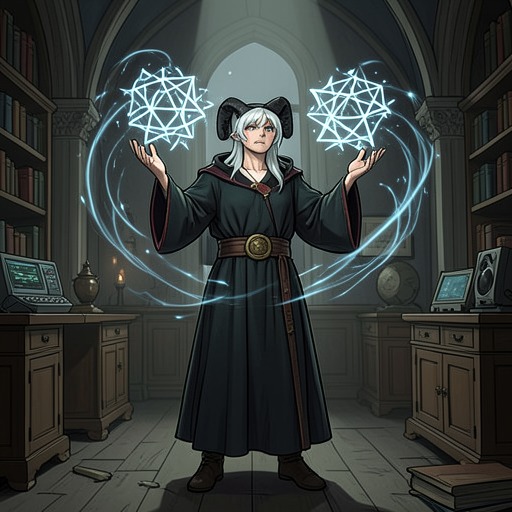
Magic is not evil. Neither is it good.
New Life as a Max Level Archmage“Magic is not evil. Neither is it good.” is the clearest formulation of the book’s central magical ethic. Spoken by Osmian while explaining ritualism to Vivisari Vexaria and Saffra, the expression rejects the idea that magic itself carries a moral purpose. It presents magic as wondrous, unstable, and potentially horrifying, making responsibility belong not to the force alone but to the beings who shape, fuel, and direct it.
Definition and Immediate Context
Osmian introduces the expression during a lecture on ritual dominion. He explains that a ritual may sacrifice anything over which its practitioner possesses conceptual control, but that weak or indistinct control makes failure more likely. Rituals are therefore fundamentally wild magic: even when a practitioner establishes a complicated framework through High Arcana, the design remains only a guide for forces that can exceed formal instructions.
The expression functions as the ethical center of that explanation. Osmian does not describe magic as malicious, benevolent, or governed by human moral categories. Instead, he calls it wondrous and warns that what appears wondrous to humanity may also be horrible beyond comprehension. The paired sentences create a deliberate balance: the first denies condemnation, while the second denies idealization.
Magic as Power Without Moral Alignment
The surrounding lesson distinguishes ritual magic from ordinary spellcasting by emphasizing predictability and control. A Fireball reliably produces a fireball with approximately stable size, speed, and power because a mage’s self-formed mana is comparatively docile. Ritual magic is less obedient, especially when it draws on forces that do not submit cleanly to the practitioner’s intent.
Osmian’s warning becomes sharper when he contrasts mana with living energy. Stealing a living being’s life force is far more unwieldy than using a mage’s own mana, while plant vitality, though less mentally complex, remains highly prone to rampage. The moral neutrality of magic therefore does not make every practice equally safe or defensible. It means that danger arises from the interaction among power, method, sacrifice, and control rather than from an inherent moral essence within magic itself.
Wider Meaning in the World
The expression stands against the religious and historical tendency to classify extraordinary power through its visible consequences. Prismarche’s Temple presents saints, heroes, and the Party of Heroes in sacred imagery, while the city’s Peace Day Festival commemorates a century since the Party of Heroes defeated the final Cataclysm. The same world remembers the Rampant Genesis of the Flesh-Weaver, the Crimson Blight brought by the Reaper of the Lost Harvest, and the Great Conflagrations called down by the Ashen Hierophant as horrors that devastated entire cities.
These memories encourage a simple opposition between heroic power and catastrophic power. Osmian’s formulation complicates that opposition. Magic may save the world or help ruin it, but neither result proves that magic itself is good or evil. The history of the Cataclysms instead shows how immense forces become morally legible through their users, purposes, and consequences.
Recurrence and Narrative Consequences
The principle returns in a broader form when Archmage Aeris considers the possibility of another catastrophe. He lists threats ranging from the Dragon King descending from the Sky-Pillar Range to an unknown horror awakening from an ancient crypt and a second Shattered Oracle arising from an overambitious glimpse. His conclusion is that there is always an Eighth Cataclysm on the horizon, even if no such disaster is occurring at that instant.
That recurrence shifts the expression from a technical maxim into a worldview. The absence of immediate catastrophe is not proof that the world is safe, just as the existence of immense magic is not proof that catastrophe is inevitable. The world remains suspended between potential and outcome, and its inhabitants must judge actions rather than merely fear or worship power.
The same tension appears in the reaction to Vivisari Vexaria’s later display of strength. After she tears a Greater Voidbeast apart with casual ease, observers are more likely to interpret the event as divine intervention than as the work of the Sorceress. Her legend is immense, but even that legend seems insufficient to explain such power. The scene shows how quickly people convert an incomprehensible magical act into a moral or religious narrative: overwhelming force is called godlike because ordinary categories cannot contain it.
Thematic Significance
The expression gives the magical system an ethical discipline without reducing it to a moral allegory. It asks readers to separate capability from character and spectacle from judgment. A wondrous act may preserve life, establish order, or inspire reverence; the same kind of power may also rampage, consume life force, or produce horrors beyond comprehension. The determining question is therefore not whether magic is pure, but who commands it, what limits guide it, what is sacrificed, and what follows.
In that sense, the expression also defines the book’s treatment of knowledge. Understanding magic does not make it harmless. Osmian’s lecture supplies rules for ritual dominion, yet he still describes rituals as wild and warns against giving magic unrestricted freedom. Knowledge creates responsibility and better judgment, not absolute mastery. The sentence remains memorable because it refuses both superstition and complacency: magic is neither a devil to be condemned nor a blessing to be trusted without question.